Complete guide · Tor · PGP · OPSEC

How to Access Torzon Safely — Complete 2026 Guide

This guide shows you how to access Torzon the right way in 2026 — Tor, PGP, crypto privacy, and OPSEC, with concrete settings and real numbers. Whether you have used Torzon before or you are setting up for the first time, the same fundamentals apply. Read it once, set things up, and the routine becomes second nature.

What Is Torzon Market

Torzon market launched in September 2022 and has run continuously since, growing into one of the top three to four marketplaces worldwide by 2026. The scale is real: over 20,000 listings — up 74% in six months — with tens of thousands of active buyers and several thousand vendors. Annual turnover sits near $15 million. Uptime held above 98% across 2026, downtime averaging under four hours a month.

What sets Torzon market apart is its mix of breadth and privacy engineering. It supports several cryptocurrencies, runs a multi-signature escrow with time-locked contracts, and was an early adopter of post-quantum cryptography. The team has stayed consistent since launch and keeps pseudonymous identities for operational reasons. The marketplace joined the Dread superlist — the community's register of markets judged trustworthy — and it backs that standing with a 99.3% dispute resolution rate.

Account tiers (Basic, Basic-Plus, Premium) shape features and escrow extensions on Torzon. A PGP verified vendor import system, introduced in 2023, lets reputable sellers carry their reputation in — a genuine first for the space. There is strong search with 10+ filter parameters and a daily raffle for active accounts. Knowing what Torzon market is makes the rest of this guide easier: you are learning to reach a stable, privacy-focused marketplace, and to do it without exposing yourself along the way.

Setting Up Tor Browser for Torzon

How to access Torzon safely 2026 — Tor Browser setup and verified onion link

Tor Browser is the only correct way to access Torzon. Download it from the official Tor Project site — torproject.org — and never from a mirror, a "modified" build, or a mobile fork. Mobile is officially unsupported because phones leak device identifiers that can break your anonymity.

Once installed, change one setting before anything else. Open the shield menu and set the security level to Safest. This disables JavaScript across all sites, and disabled JavaScript is one of the strongest defenses against deanonymization attacks that try to fingerprint or unmask you. The default level leaves JavaScript on; Safest turns it off. Make the change immediately.

Two more habits. Do not resize the browser window — keeping the default dimensions makes your fingerprint look like everyone else's, while a unique window size makes you stand out. And do not install extensions; each one adds an identifiable trait. Tor Browser is tuned to make all users look alike. Every customization you add chips away at that. Keep it stock, set it to Safest, and you have the access layer right.

Using Tails or Whonix with Torzon

Tor Browser protects your traffic, but it runs on top of your normal operating system, which can still keep traces. Tails and Whonix close that gap, and for serious access to Torzon either one is worth the small setup effort.

Tails

Tails is an amnesic operating system you boot from a USB stick. It routes everything through Tor and forgets everything at shutdown — no files, no history, nothing written to your computer's disk. Pull the USB and it is as if you were never there.

Whonix

Whonix takes a different route: it splits into two virtual machines, a gateway and a workstation, and forces all workstation traffic through Tor at the network level. Even malware on the workstation cannot leak your real IP, because it physically cannot reach the network except through Tor.

Which should you pick? Tails for a clean, leave-no-trace session on borrowed or shared hardware. Whonix for a persistent, compartmentalized setup on a machine you control. Either beats Tor Browser alone on your daily operating system. The marketplace itself strongly recommends desktop access through Tails or Whonix for exactly this reason. Pick one and your foundation is solid.

Torzon PGP — Encrypt & Verify

Torzon onion security 2026 — PGP verification, escrow and warrant canary

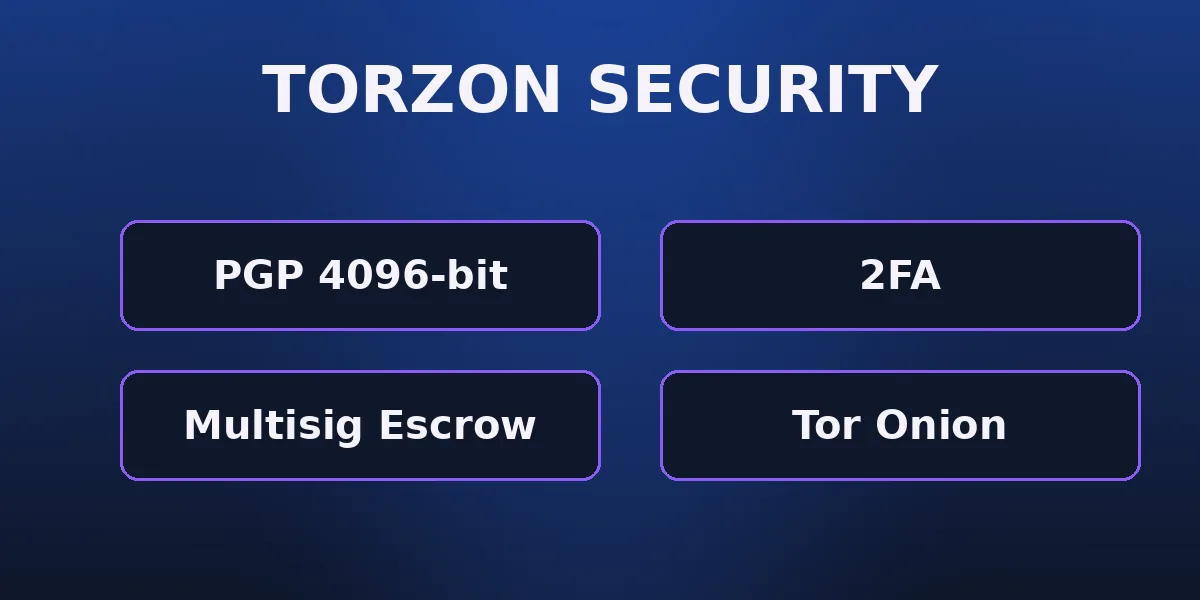
PGP is the backbone of safe communication on Torzon, and it does two jobs: it encrypts your messages so only the intended reader can open them, and it verifies signatures so you can prove a message genuinely came from who it claims. Both matter. Here is how to get set up, four steps:

  1. Install GnuPG (command line) or Kleopatra (graphical, part of Gpg4win). Either manages keys and signatures.
  2. Generate your own key pair at 4096-bit RSA. Keep the private key secret and protected with a strong passphrase; share only the public key.
  3. Import the marketplace public key and confirm its fingerprint matches the one pinned on Dread.
  4. Verify the signature on the marketplace's mirror announcement before trusting any address — a good signature proves the message came from the key holder.

Why does this matter for access specifically? Because verifying a Torzon link is just signature verification applied to an onion address. A phishing clone can copy a login page perfectly, but it cannot forge a signature without the private key. So when you check the marketplace's signature over its mirror list and the address matches, you know the link is genuine. Encrypt your vendor messages with the vendor's public key, sign where appropriate, and never send anything sensitive in the clear. PGP turns "I hope this is real" into "I verified this is real."

Torzon Cryptocurrency Privacy — XMR vs BTC

Payment privacy on Torzon comes down to a choice between Monero and Bitcoin, and the two are not close on anonymity. Understanding the difference helps you decide where to sit.

Monero (XMR)

Monero is the privacy default, with a low 0.5% fee. Three protocol features work together. Ring signatures blend your transaction with others so the real sender is hidden. Stealth addresses create a fresh one-time address for every payment, concealing the receiver. Confidential transactions hide the amount. The combined effect: a Monero payment reveals almost nothing on its own ledger. Privacy is built into the protocol, on by default, for every transaction.

Bitcoin (BTC)

Bitcoin carries a 2% fee and a fully public blockchain, so privacy has to be added on top. Torzon integrates a CoinJoin service to mix coins and break the ownership trail, supports the Lightning Network for faster cheaper payments, and applies address rotation and transaction obfuscation. These tools genuinely raise the bar against blockchain analysis, but Bitcoin's ledger is public by design, so it will never match Monero's on-chain anonymity.

There is a bridge between them: Torzon runs built-in Monero-Bitcoin atomic swaps, letting you convert without an outside exchange, and time-delayed withdrawals add another privacy layer. The straightforward advice — if privacy is your priority, use XMR. Lower fee, stronger anonymity, less to worry about on-chain. If you only hold BTC, the mixing and Lightning tools cover you reasonably well, but consider swapping to XMR for the sensitive leg.
Monero · XMR / USD
24h —
Bitcoin · BTC / USD
24h —

Torzon OPSEC Basics

Operational security is the set of habits that keep your real identity separate from your Torzon activity. The marketplace's own cryptography is strong; poor OPSEC on your end is what actually unmasks people. Here is a working checklist, nine habits:

  1. Use Tor Browser at the Safest level for every connection, JavaScript disabled.
  2. Run Tails or Whonix rather than your everyday operating system.
  3. Never use your real name, real email, or any personal information anywhere.
  4. Create a unique username and password for Torzon, reused on no other site.
  5. Encrypt anything sensitive with PGP before it touches the network.
  6. Verify every link's PGP signature before connecting — never trust an address from a DM or email.
  7. Avoid mobile devices entirely; they leak identifiers and are officially unsupported.
  8. Never use your daily computer; use dedicated hardware or an amnesic system where possible.
  9. Keep your darknet life and your clearnet life completely separate — no shared usernames, no shared anything.

The thread running through all nine is separation. Every link between your real identity and your marketplace activity is a thread someone could pull. Cut the threads before they exist. OPSEC is not about one clever trick; it is about boring, consistent discipline that gives an investigator nothing to grab. Do these every time and you have closed the gaps that technology alone cannot.

Escrow & Buyer Protection on Torzon

Escrow is how Torzon protects your money during a trade, and its design is unusually strong. The system is 2-of-3 multi-signature: you hold one key, the vendor holds one, and the platform holds the third, used only for dispute resolution. Releasing funds needs two of the three signatures, which means no single party — not even an administrator — can move the money alone.

On top of that sits a time-locked smart contract. If a dispute is not resolved within 14 days, the funds return to you, the buyer, automatically. No operator approval, no manual step. Auto-finalization follows a clear schedule: 14 days for international orders, 7 for domestic, with extensions depending on your account tier. Trusted vendors may offer Finalize Early, where you accept the risk for an instant release.

The structural piece behind all this is that Torzon is walletless — it holds no internal balances and keeps no large cryptocurrency reserves. You fund each escrow directly; there is no central pool. That design removes the single biggest failure mode of custodial markets and lines the platform's incentives up with yours, since it earns on commissions rather than by holding funds. Combined with the 99.3% dispute resolution rate, the result is buyer protection you can actually rely on. Ready to connect? Start with the verified Torzon link or the current Torzon mirrors.

How to Access Torzon — Frequently Asked Questions

Download Tor Browser only from torproject.org, set the security level to Safest to disable JavaScript, then copy a verified Torzon link and open it. Do not resize the window or add extensions. For stronger protection, run Tor inside Tails or Whonix rather than your everyday operating system.

Torzon has operated since September 2022 with no documented breaches, 98%+ uptime, a 99.3% dispute resolution rate, and a place on the Dread superlist. Its walletless multi-signature escrow means even administrators cannot move user funds alone. Your own OPSEC — verified links, unique credentials, PGP — is the other half of staying safe.

Yes, practically speaking. PGP is mandatory for vendor communication and is how you verify that a Torzon link is genuine rather than a clone. Generate a 4096-bit key with GnuPG or Kleopatra, import the marketplace public key, and verify signatures. It takes a couple of minutes once set up.

Monero offers stronger privacy at a lower fee (0.5% versus 2%), with ring signatures, stealth addresses, and confidential transactions shielding sender, receiver, and amount. Bitcoin works with CoinJoin mixing and Lightning support layered on, but its public ledger limits privacy. For most buyers, XMR is the better choice.

Funds go into a 2-of-3 multi-signature account needing two keys to release, so no single party can take them. A time-locked contract returns funds to you automatically if a dispute is unresolved after 14 days. The platform is walletless, holding no central reserve, which removes the largest custodial risk.

Torzon supports layered two-factor authentication: TOTP via an authenticator app, PGP-based 2FA, and phishing-resistant hardware keys like YubiKey. Enabling 2FA — especially a hardware key, which will not authenticate to a clone — is one of the strongest steps you can take to protect your account.

Mirror addresses rotate on purpose to resist DDoS attacks and tracking, and to balance traffic. Torzon runs 9+ mirror onion URLs. That is why a verified, frequently updated source beats any static list — posted addresses rotate away, while a signed source stays current.

Verify the marketplace's PGP signature over its mirror list, confirm the public key fingerprint against Dread, and cross-check the warrant canary, which updates every 72 hours. A clone can copy the page but cannot forge the signature. Match the signature and the address, and the link is real.

It is strongly discouraged. Mobile devices leak identifiers that can compromise your anonymity, and mobile is officially unsupported for safety. Use a desktop with Tor Browser, ideally inside Tails or Whonix. The small inconvenience buys a real security gain.

A warrant canary is a cryptographically signed statement the marketplace publishes every 72 hours, referencing recent news to prove its freshness. As long as it updates on schedule with a valid signature, it confirms the platform has not been compromised. If it stops or the signature changes, users are warned — transparency you can verify yourself.

Ready to Connect to Torzon

You have the setup — Tor at Safest, PGP imported, OPSEC in place. The last step is the link. Head to the current verified mirror list, or grab the official Torzon link from the homepage. Verify the signature, use a unique login, and pay in XMR if privacy is your priority.